The post Meta Group Claim- National Media appeared first on Richardson Hartley Law.
]]>The claim, brought jointly with Humphries Kerstetter solicitors, was publicised this weekend and has attracted an overwhelmingly positive response from victims across the country.
The Sunday Times, Daily Mail and Daily Express have all covered news of the Meta group claim, which is one of the most significant legal challenges to Meta’s handling of fraudulent advertising in the UK.
Martin Lewis’ Money Saving Expert website has also reported on the group legal claim.
The claim centres on the systematic use of Facebook and Instagram to serve fraudulent investment advertisements to UK consumers – including deepfake videos of well-known figures such as Martin Lewis – which directed victims to investment scams resulting in significant financial losses.
Martin Richardson said: “These are not random frauds that happened to use social media. Meta’s advertising platforms were the vehicle through which victims were targeted and deceived, often repeatedly. The scale of what has happened is enormous and Meta has both the means and the responsibility to have done more to prevent it.”
The law firms have spent months bringing the Meta group claim together to help scam victims. The more people who come forward, the stronger the group action becomes.
Every year, tens of thousands of British consumers are scammed out of their savings after responding to fraudulent advertisements on Facebook and Instagram promoting fake investment schemes, cryptocurrency fraud, and bogus financial products.
The human cost is devastating: an initial sign-up process run by Richardson Hartley Law, which has already signed up hundreds of victims to join the claim, found that the average loss per victim stands at around £37,000, often representing life savings accumulated over decades. Despite the scale of the harm, neither the British Government nor its regulators have moved decisively to hold Meta to account, leaving victims with nowhere to turn.
Earlier this month money guru Martin Lewis and consumer champions Which? wrote to the Prime Minister Keir Starmer demanding urgent action against the plague of online fraud. “Major online platforms are not just hosting criminal activity, they are actively profiting from it,” the letter stated.
The law firms say that they hope by bringing this group action it will help to incentivise Meta to address scam adverts shown on Facebook and Instagram.
The case follows a series of explosive Reuters investigations using Meta’s own internal documents, which claimed that the company had knowingly profited from fraudulent advertising. The report claimed that if Meta suspected an advert was fraudulent then it would charge the scammers more money and only took down the offending advert it was 95% certain it was a fraud.
Toby Starr, Partner at Humphries Kerstetter, which is currently running an adtech claim against Google, said: “The internal documents uncovered by Reuters go to the very core of what Meta knew, when it knew it, and what it chose to do – or not do – about it. When a company repeatedly makes decisions that harm a vast number of individuals through the same course of conduct, those individuals have every right to seek collective redress. The strength of the evidence here is significant, and we intend to use it.”
At the heart of the case is Meta’s sophisticated tracking and targeting infrastructure; a system the two firms say has been used to deliver fraudulent investment schemes, fake cryptocurrency products, and bogus financial promotions to the consumers most vulnerable to them with chilling precision.
The action is being pursued on a no-win, no-fee basis. Anyone who lost £2,000 or more after responding to a fraudulent advertisement on Facebook or Instagram in the past six years may be eligible to join.
Read the some of the media coverage of the claim:
If you lost money to a scam advert on Facebook or Instagram, visit www.metagroupclaims.co.uk.
The post Meta Group Claim- National Media appeared first on Richardson Hartley Law.
]]>The post Ponzi Schemes- Daily Express Column appeared first on Richardson Hartley Law.
]]>
Fraud now accounts for nearly half of all crime in the UK.
Everyday we hear about the financial and emotion devastation cause by fraud to our clients
What has become a huge concern for us is the growth of multi-million pound Ponzi schemes where the fraudsters seems to act with seeming impunity.
At Richardson Hartley Law we have developed increasing diverse routes in helping Ponzi scheme victims to recover their money but we strongly believe that the Government needs to create stronger deterrents.
Please read Martin’s Daily Express column in full below.
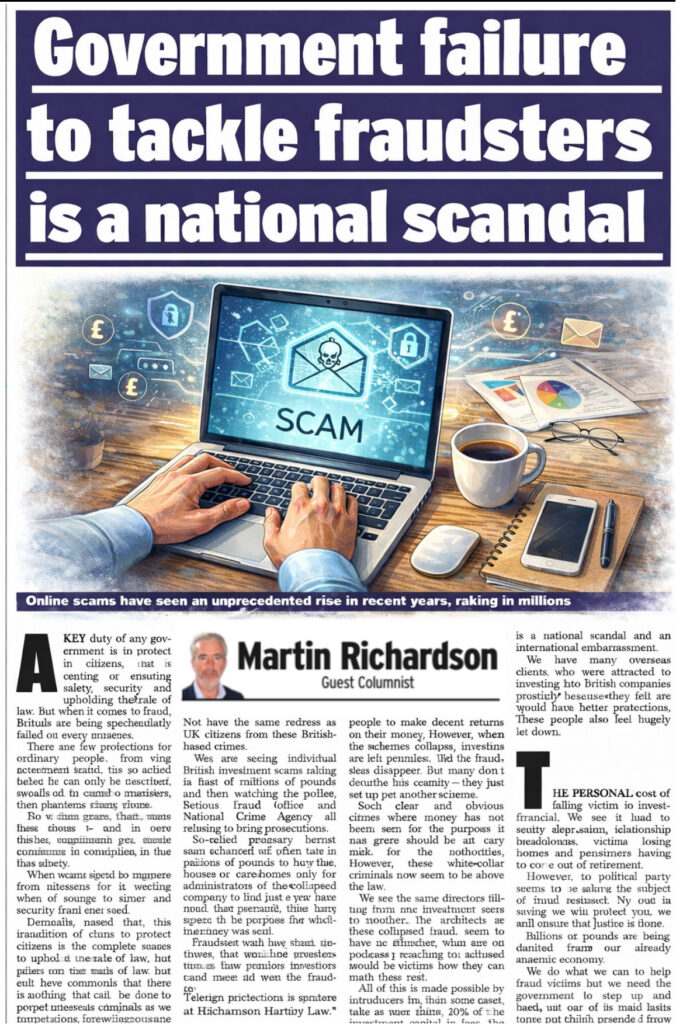
Government Failure To Tackle Fraudsters Is A National Scandal
“A key duty of Government is to protect its citizens. This is centred on ensuring safety, security and upholding the rule of law.
When it comes to fraud, British citizens are being spectacularly failed on every measure.
There are very few protections for ordinary people from the scourge of fraud. This is so acute that I now believe it can only be described as serious failure of Government.
Last year, we predicted there would be a rise in overseas scams and fraud fueled by artificial intelligence. There is no doubt this has occurred. Foreign criminals are targeting the UK and sucking out billions of pounds.
We all know that social media sites are allowed to host and peddle scam adverts to help lure in unsuspecting victims. Telecommunication giants also help send out scam texts and phone calls every second of every minute.
It seems the Government is too scared to hold these behemoths to account. It is estimated that Meta which owns Facebook, WhatsApp and Instagram sees more than 50% of UK fraud operated through, or started from, their platforms.
What other company would be allowed to operate as a conduit for criminality?
Where is the protection from Government for its citizens when it come to safety and security from foreign fraud.
Arguably, worse than this dereliction of duty to protect its citizen’s, is the complete failure to uphold the rule of law.
You will hear that arguments that there is nothing that can be done to thwart overseas criminals as we cannot arrest and prosecute the perpetrators.
However, the real scandal is that we are seeing a huge rise in fraud being perpetrated with impunity by British citizens.
Ponzi schemes are now rife in the UK. In fact, the country has become a centre for fraudulent investment schemes. Ironically, overseas victims do not have the same redress as UK citizens from these British-based crimes.
We are seeing individual British investment scams raking in tens of millions of pounds and then watching the police, Serious Fraud Office and National Crime Agency all refusing to bring prosecutions.
So-called property investment schemes will often take in millions of pounds to buy flats, houses or care homes only for adminstrators of the collapsed company to find just a few hundred thousand pounds were spent on the purpose for which the money was sent.
The fraudsters create glossy brochures, have high-end websites and sophisticated online platforms that investors can log into. They even have genuine offices that would-be investors can visit and meet the fraudsters face-to-face.
To the outside world they look a fantastic opportunity for people to make decent returns on their money.
However, when the schemes collapses the investors are left penniless and the fraudsters disappear. But many don’t flee the country. Instead, they just set up another scheme.
Such clear and obvious crimes where money has not been used for the purpose it was given should be an easy nick for the authorities. However, these white collar criminals now seem to be above the law.
We see the same directors flitting from one investment scam to another.
The architects of these collapsed frauds seem to have no shame. Many are on podcasts preaching to their next would-be victims how they can make them rich.
All of this is made possible by introducers who, in some schemes, are taking as much as 20% of the investment capital as an introductory fee.
The failure of Government to hold any of these people to account is a national scandal and an international embarrassment.
We have many overseas clients who were attracted to investing into British companies precisely because they felt we would have better protections. These people also feel hugely let down.
The personal cost of falling victim to these investment scams isn’t just financial. We see it lead to severe depression, relationship breakdowns , victims losing their homes and pensioner having to come out of retirement.
However, no political party seems to be taking the subject of fraud seriously.
Noone is saying; we will protect you, we will ensure that justice is done.
Even on a economic front it seems madness no one sees fraud as top priority. Billions of pounds are being drained from our already anemic economy.
We do what we can to help fraud victims but we need the Government to step up and carry out one of its most basic duties- protecting its citizens.”
Have you lost money to a Ponzi scheme? If so, contact us today to see how we can help.
The post Ponzi Schemes- Daily Express Column appeared first on Richardson Hartley Law.
]]>The post APP Fraud Parliamentary Report appeared first on Richardson Hartley Law.
]]>We hosted an event at the Houses of Parliament attended by stakeholders to discuss the report which had revealed that fraud in the UK was eight times higher than previously reported.
The story of the APP fraud report was picked up by The Express, The Times, The Sun and the Mirror newspapers. Reporters from the FT, Daily Mail and Which magazine? also attended the event.
While banks and regulators have said that APP fraud payments stand at around £380million a year, the report calculates that these losses are, in reality, about £3billion per annum.
MP Phil Brickell MP, who prior to his election in July 2024 worked for more than a decade across a number of financial institutions tackling financial crime and corruption said: “The findings of this report reconfirm my gravest fear – that fraud is one of the biggest challenges facing our country today. Banks spend billions of pounds every year trying to contain the problem. But given the prevalence of fraudsters on social media platforms, tech firms in particular need to go much further to protect consumers and businesses.”
As well as MPs and journalists, the event has attended by banks, other payment service providers, fraud victims and regulators.
Martin Richardson, senior partner at Richardson Hartley Law, said: ‘The event was a great success. There was huge consensus in the room that everyone must do more to fight the fraud plague.
‘It was a good opportunity to raise awareness of APP fraud in the media.
‘We cannot leave the fight to the banks. Everyone needs to be better at fraud prevention, particularly tech platforms.
‘Our law firm will always fight for scam victims to reclaim their money but we also want to help prevent fraud.’
If you have lost money through APP fraud contact us today.
The post APP Fraud Parliamentary Report appeared first on Richardson Hartley Law.
]]>The post Fraud Opinion Piece- Daily Express appeared first on Richardson Hartley Law.
]]>FORCING EVERYONE TO BANK ONLINE IS A GIFT TO FRAUDSTERS
Fraud in Britain is out of control and it’s going to get a lot worse.
Anyone can fall victim, but research shows two distinct age groups are hit the hardest.
The first are in their 20s – youngsters brought up with social media and platforms such as Instagram and TikTok that others remain scep
tical about. This makes this age group particularly vulnerable to eye-catching adverts for cryptoinvestments and “get rich quick” schemes.
The second group of victims are the 65-and-overs. Whatever your age, technology can be baffling, but for the generation who never asked for online banking or apps and yet are increasingly forced to conduct their lives via the internet, the rise of digital Britain has brought the greatest danger.
When banks started closing their local branches across the country, we were told it wouldn’t affect the customer experience. They promised that
technology would make it easier and that more and more people wanted the convenience of online banking. The problem is many people didn’t – and still don’t.
Gone are the days when a friendly bank manager and cashiers knew their customers, could give them advice and keep an eye on them.
These people were the first line of defence against fraudsters. They could warn custom ers about payments to certain individuals or organisations.
NOW, anyone sendingmoney electronically gets a message asking if they’re sure it’s not a scam. If they thought it was a scam, they obviously wouldn’t be sending the money! It quickly becomes meaningless to automatically ask the question each time. Familiarity breeds contempt, it loses its meaning and, actually, doesn’t really give much defence to a bank who wants to claim it has anti-fraud measures
in place.
I was struck by a recent case of an elderly client in the early stages of dementia whose local bank branch closed.
Forced to set up online banking on his phone, he asked a trustedcarer to help set up the banking app. Unbeknown to him, the same “carer” began syphoning money and eventually stole more than £60,000.We wrote to the bank explaining that he had been defrauded and warning them that they should have spotted the unusual spending patterns that appeared on his account.
Overnight, he went from spending £200 a week to having thousands of pounds leave his account in huge transactions.
The bank has, so far, refused to refund the gentleman, saying he should not have allowed the carer (considered a close family friend) to set up the app. His
family and I have no doubt this fraud couldn’t have happened were the bank branch – where he had known everyone for decades – still open. Naturally,
we are fighting our client’s case.
I make the gloomy prediction that financial scams are going to get worse because we’ve all been forced to let technology into every part of our lives –
and this has been an absolute gift to the fraudsters.
It doesn’t matter how savvy you are – we’re all vulnerable. Research by Citizens Advice earlier this week suggested one in five Britons have fallen victim to a financial scam in the last year alone – a staggering nine million victims.
Fraud is a multi-billion pound global industry which can afford to invest in the latestinnovations. Scammers are already using artificial intelligence and the reality is that this is only going to accelerate exponentially, meaning more messages mimicking loved-ones asking for money and evermore convincing and better targeted scams.
At Richardson Hartley Law, we are determined to not only help recover fraud victims’ money, but to help prevent scams in the first place.
We have set up National Fraud Helpline to help lead the fightback against cons.
The website has all the latest fraud warnings and information.
In addition we have joined forces with leading UK AI company, Time Machine Capital Squared, to help create innovative anti-scam products. We’re
also campaigning for change at a national level, by sponsoring the All Party Parliamentary Group for Fair Banking’s report into “Authorised Push Payment
Fraud and Banks”.
A noticeable trait with scams against the elderly is how they very often represent the highest amounts of money that have been stolen. It’s devastating and more needs to be done to protect them.
In the meantime, let’s not force people into using technology at every turn.
● Martin Richardson is a solicitor at Richardson Hartley Law.
The post Fraud Opinion Piece- Daily Express appeared first on Richardson Hartley Law.
]]>