The post Scam Meta Ads- Good Morning Britain appeared first on Richardson Hartley Law.
]]>Richardson Hartley Law has joined forces with Humphries Kerstetter to create a group claim against Meta, the parent company of Facebook and Instagram, over its alleged failure to remove fraudulent advertisements from its platforms.
Martin was joined on the programme by Lynda Cameron, one of the victims who lost money as a result of a scam promoted through Meta’s social media platforms. The pair were interviewed by hosts Susanna Reid and Ed Balls, with later describing the situation as “shocking” during the broadcast.
Speaking on the programme, Mr Richardson set out the legal basis for the claim and the scale of the harm caused to ordinary people across the UK. He emphasised that Meta has the technology and the resources to detect and remove fraudulent advertisements, and that its failure to do so is not a passive oversight; it is a choice that has generated revenue for the platform while leaving victims with devastating losses.
Meta Faces Group Action Over Scam Ads
The two law firms are is pursuing a group claim against Meta on behalf of victims who were deceived by scam advertisements that appeared on Facebook and Instagram.
The group action is being brought via metagroupclaims.co.uk, where affected individuals can register their interest and find further information about the claim.
Lynda Cameron’s Story
Lynda Cameron appeared alongside Martin to share her own experience of being defrauded through an advertisement on Meta’s platforms. Her account illustrated the very human cost of scam advertising – the financial damage, the emotional impact, and the frustration of discovering that the platform through which the fraud was delivered had warnings it failed to act upon.
Lynda’s appearance on Good Morning Britain puts a face to the thousands of victims across the UK who are in similar positions and demonstrates why collective legal action is so important.
How to Join the Group Claim
If you or someone you know has lost money as a result of a scam promoted through Facebook or Instagram, you may be eligible to join the group action against Meta.
Visit metagroupclaims.co.uk to register your interest or find out more.
The post Scam Meta Ads- Good Morning Britain appeared first on Richardson Hartley Law.
]]>The post Yield Gallery – Daily Telegraph appeared first on Richardson Hartley Law.
]]>The firm operated gallery sites in Mayfair and Blackheath and sold works by high-profile artists, most notably Richard Hambleton – a Canadian street artist sometimes described as the godfather of street art, whose shadowy figures attracted significant investment interest.
While we have recovered £100,000 for one investor we are still working to recover the investment money for many more.
Investors were told their pieces would be stored securely, that a forthcoming Netflix documentary would push Hambleton prices higher, and that they were buying into a carefully curated, professionally managed market.
The galleries themselves were designed to inspire confidence. Champagne receptions, private viewings, and polished Mayfair premises all contributed to an image of professionalism and prestige. Investors who visited in person came away reassured. As the Telegraph reported, the gallery had once been described as a “quiet powerhouse” in London’s art market, said to sell Banksy and Hockney without the hype while developing emerging talent.
What the Daily Telegraph reported
The Telegraph spoke to a number of our Yield Gallery investors whose experiences illustrated how the scheme operated and how devastating the consequences had been.
One investor, a 61-year-old IT worker from London, had initially purchased a piece by an up-and-coming artist after visiting the gallery. He was then encouraged to invest in Hambleton’s work on the strength of the upcoming Netflix documentary, which salespeople suggested would significantly boost prices. He paid £25,000 for a Hambleton piece called Gang of Four, transferred from his Barclays account, and was given a certificate of authenticity. He has no idea where the work is now. “This was meant to be my future,” he told the newspaper.
A London pharmacist described his “shame and embarrassment” having lost more than £100,000. After extensive research and a visit to the Mayfair site, he purchased several Hambleton works including a piece called Rodeo, which he was told was being held at the Woodward Gallery in New York. The Telegraph confirmed that the Woodward Gallery had never stored art on behalf of Yield Gallery, and that the piece had ultimately been sold to an entirely different collector. On visiting the Mayfair gallery to raise his concerns, he found it empty.
A third investor told the Telegraph he had paid £55,000 for a Hambleton work in March 2024, followed by a further £45,000 two months later for another piece — both supposedly held in storage. After the gallery went into liquidation, he saw an Instagram post of the striking Rodeo work he believed he owned. It had been posted online by a New York gallery. That gallery told the newspaper it had been the owner throughout and that a potential purchase by Yield Gallery had never been completed.
It was Richardson Hartley Law’s representation of that investor that enabled him to recover the his investment through his bank, Nationwide. As he told the Telegraph: “I’ve been lucky.”
What the Insolvency Service found
The company, which traded as Artwork Holdings Ltd, was wound up at the High Court in May 2025. The Insolvency Service found that it appeared to have ceased trading in late 2021 or early 2022 -yet continued taking money from investors until at least April 2024.
Critically, the official liquidator confirmed they could find no evidence of any storage facilities operated by Yield Gallery. Works that investors believed they owned had, in some cases, been sold elsewhere without their knowledge or consent.
Richardson Hartley Law’s involvement
Richardson Hartley Law has been contacted by more than 20 investors, with combined losses running to several million pounds. One client has lost around £800,000 in total.
We have already secured a full £100,000 recovery for one client through the bank reimbursement scheme and are actively pursuing claims for further investors across all available routes.
Martin Richardson, senior partner at Richardson Hartley Law, said: “We are currently looking at a variety of ways to help clients, including bank reimbursement schemes. We have recovered £100,000 for one client and the other cases are ongoing. The Yield Gallery collapse is a deeply concerning case.”
If you invested through Yield Gallery and you are unable to locate your artwork, have been unable to sell pieces you were told were in storage, or have received no meaningful response from the gallery or its representatives, we would very much like to hear from you.
We are particularly keen to hear from investors who purchased works by Richard Hambleton.
Read The Telegraph article in full: How a mysterious Mayfair gallery left investors ‘millions’ out of pocket
The post Yield Gallery – Daily Telegraph appeared first on Richardson Hartley Law.
]]>The post Halcyon Retreat- The Times appeared first on Richardson Hartley Law.
]]>A former British police officer has been arrested in Spain following a French fraud investigation linked to a collapsed luxury resort project.
Richardson Hartley Law is representing a number of UK clients who can fear they have lost money in the scheme.
Our senior partner Martin Richardson and one of our clients spoke to the newspaper about the case.
Mr Richardson told The Times: “The clients were sold a dream that has turned into a nightmare. Many have lost their life-savings.
“The arrest of Robin Barrasford on suspicion of fraud is certainly very interesting as we explore exactly what has happened in this case. Mr Barrasford’s arrest may make it easier for us to make claims on behalf of our clients who potentially wish to seek financial redress through bank fraud reimbursement models.“
The Times reported how Robin Barrasford, 56, was detained after French authorities issued an arrest warrant via the public prosecutor’s office in Bordeaux, with extradition now being sought.
Searches were also carried out in Marbella and London in connection with the Wyndham Halcyon Retreat Golf and Spa Resort – a development planned in the Creuse département of France, near the 19th-century Château de la Cazine.
Announced in 2013, the project promised a luxury complex of 358 residences, a golf course and spa, with investors invited to pay up to £1.1 million for a residence. Barrasford and his business partner, Alan Bird, 70, are directors of Halcyon Retreat, the French-registered firm behind the project. Investor documents also reference Halcyon Developments Group, based in Devon.
The resort never got off the ground. Dozens of investors say they have lost their life savings.
One of Richardson Hartley Law’s clients also agreed to speak to The Times about his investment.
Ray Holmes, 65, a retired local government officer from Derbyshire, agreed to pay £37,885 for a one-thirteenth share of a flat at the resort in 2022 after seeing it mentioned by the website of Channel 4’s programme A Place in the Sun.
Holmes, who became a father for the first time at 61, said he saw the residence as an investment but also a “place to give us some family memories. You realise at my age that you are only going to have a finite time with your daughter and so … it seemed like an attractive thing.”
He said the developers sent photographs taken from drones of the site. Initially, they showed work under way. “But then the drone flythroughs showed nothing much happening and that is when I started to get worried.”
Holmes received an initial payment of £1,136.58 but then nothing more until he posted a critical review of the project online, at which point he says Barrasford contacted him. He subsequently received a further payment of £1,421 last year but has had nothing since then.
He only paid 50 per cent of the purchase price because the rest was due after building work that has never been completed.
Nevertheless, he says he has lost about a third of his lump-sum pension payout he received upon his retirement. “It hasn’t put us on the streets but it would have been handy to have that almost £19,000,” he said.
Devon and Cornwall Police confirmed they are investigating reports of fraud relating to property investments linked to a former Tavistock-based company. No arrests have been made in the UK. Alan Bird has not been arrested and is not under criminal investigation.
Richardson Hartley Law is currently advising more than 12 investors, with senior partner Martin Richardson describing the situation as “a dream that has turned into a nightmare.”
Read The Times article in full: Former British police officer arrested over alleged French property scam
The post Halcyon Retreat- The Times appeared first on Richardson Hartley Law.
]]>The post Ponzi Schemes- Daily Express Column appeared first on Richardson Hartley Law.
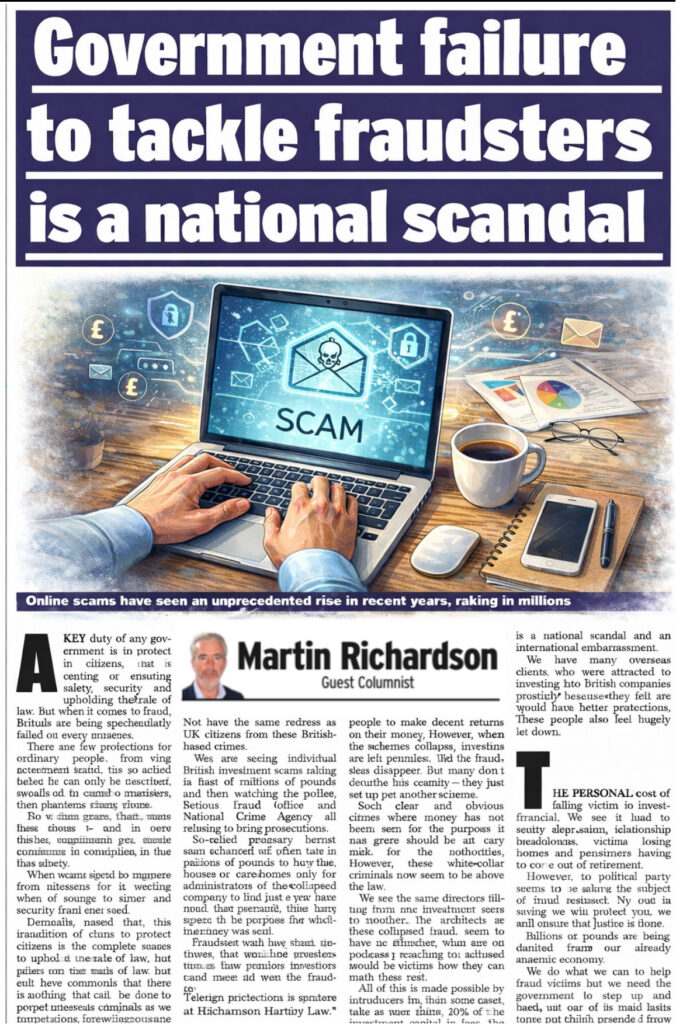
]]>
Fraud now accounts for nearly half of all crime in the UK.
Everyday we hear about the financial and emotion devastation cause by fraud to our clients
What has become a huge concern for us is the growth of multi-million pound Ponzi schemes where the fraudsters seems to act with seeming impunity.
At Richardson Hartley Law we have developed increasing diverse routes in helping Ponzi scheme victims to recover their money but we strongly believe that the Government needs to create stronger deterrents.
Please read Martin’s Daily Express column in full below.
Government Failure To Tackle Fraudsters Is A National Scandal
“A key duty of Government is to protect its citizens. This is centred on ensuring safety, security and upholding the rule of law.
When it comes to fraud, British citizens are being spectacularly failed on every measure.
There are very few protections for ordinary people from the scourge of fraud. This is so acute that I now believe it can only be described as serious failure of Government.
Last year, we predicted there would be a rise in overseas scams and fraud fueled by artificial intelligence. There is no doubt this has occurred. Foreign criminals are targeting the UK and sucking out billions of pounds.
We all know that social media sites are allowed to host and peddle scam adverts to help lure in unsuspecting victims. Telecommunication giants also help send out scam texts and phone calls every second of every minute.
It seems the Government is too scared to hold these behemoths to account. It is estimated that Meta which owns Facebook, WhatsApp and Instagram sees more than 50% of UK fraud operated through, or started from, their platforms.
What other company would be allowed to operate as a conduit for criminality?
Where is the protection from Government for its citizens when it come to safety and security from foreign fraud.
Arguably, worse than this dereliction of duty to protect its citizen’s, is the complete failure to uphold the rule of law.
You will hear that arguments that there is nothing that can be done to thwart overseas criminals as we cannot arrest and prosecute the perpetrators.
However, the real scandal is that we are seeing a huge rise in fraud being perpetrated with impunity by British citizens.
Ponzi schemes are now rife in the UK. In fact, the country has become a centre for fraudulent investment schemes. Ironically, overseas victims do not have the same redress as UK citizens from these British-based crimes.
We are seeing individual British investment scams raking in tens of millions of pounds and then watching the police, Serious Fraud Office and National Crime Agency all refusing to bring prosecutions.
So-called property investment schemes will often take in millions of pounds to buy flats, houses or care homes only for adminstrators of the collapsed company to find just a few hundred thousand pounds were spent on the purpose for which the money was sent.
The fraudsters create glossy brochures, have high-end websites and sophisticated online platforms that investors can log into. They even have genuine offices that would-be investors can visit and meet the fraudsters face-to-face.
To the outside world they look a fantastic opportunity for people to make decent returns on their money.
However, when the schemes collapses the investors are left penniless and the fraudsters disappear. But many don’t flee the country. Instead, they just set up another scheme.
Such clear and obvious crimes where money has not been used for the purpose it was given should be an easy nick for the authorities. However, these white collar criminals now seem to be above the law.
We see the same directors flitting from one investment scam to another.
The architects of these collapsed frauds seem to have no shame. Many are on podcasts preaching to their next would-be victims how they can make them rich.
All of this is made possible by introducers who, in some schemes, are taking as much as 20% of the investment capital as an introductory fee.
The failure of Government to hold any of these people to account is a national scandal and an international embarrassment.
We have many overseas clients who were attracted to investing into British companies precisely because they felt we would have better protections. These people also feel hugely let down.
The personal cost of falling victim to these investment scams isn’t just financial. We see it lead to severe depression, relationship breakdowns , victims losing their homes and pensioner having to come out of retirement.
However, no political party seems to be taking the subject of fraud seriously.
Noone is saying; we will protect you, we will ensure that justice is done.
Even on a economic front it seems madness no one sees fraud as top priority. Billions of pounds are being drained from our already anemic economy.
We do what we can to help fraud victims but we need the Government to step up and carry out one of its most basic duties- protecting its citizens.”
Have you lost money to a Ponzi scheme? If so, contact us today to see how we can help.
The post Ponzi Schemes- Daily Express Column appeared first on Richardson Hartley Law.
]]>The post Investment Loss- National Media appeared first on Richardson Hartley Law.
]]>Our client Paul Sampson told of the devastating effects of the fraud had had on his life, leaving him homeless and, at times, being forced to sleep in his car.
The sophisticated scam included a very detailed business proposal which we have spent months investigating and proving that every facet and promise was untrue.
Barclays have initially rejected Mr Sampson’s claim under their fraud reimbursement scheme, saying that the investment loss was outside the six year limitation period.
We are currently representing Mr Sampson to the Financial Ombudsman Service to say that the post-concussion syndrome that suffered as a result of head injuries meant it was not possible for him to understand that he had been defrauded.
We got Mr Sampson a diagnosis from Dr Az Hakeem, a Consultant Psychiatrist and Medical Director of Psyche Clinic based in Harley Street, London.
He told the media: “Post concussion syndrome destroys cognitive functions that are needed to recognise fraud.
“Fraud detection requires a person to notice inconsistencies, question what they have been told, and conclude they have been deliberately deceived.
“Memory fragmentation means earlier representations cannot be held in mind long enough to compare against later events.
“The syndrome in this case was also co-presented with depression and anxiety which was exacerbated by the betrayal and Mr Sampson’s own personal experiences. This further suppressed the cognitive vigilance fraud recognition demands.
“Reading about a comparable fraud suddenly provided the framework the brain could not independently construct. Mr Sampson was not generating new reasoning – he was borrowing it. That single moment of external clarity, cutting through years of neurological fog, is entirely consistent with this condition.”
Speaking of Mr Sampson’s investment loss, Martin Richardson, senior partner at Richardson Hartley Law, said: “We’ve managed to prove that every part of the business proposal given to Mr Sampson was fictious.
It appears that they saw a vulnerability in Paul and took advantage.
“Mr Sampson’s love of the military was also exploited as they claimed part of his role would be to help veterans.
“This was a well planned and well executed strategy to take all of Paul’s savings. It’s ruined his life.
“We believe that there’s a very strong argument to say that the only reason Paul didn’t bring his claim within the six year limitation period was because of the post concussion syndrome that he suffers from. This is backed up by the psychiatrist’s report.
“We are currently awaiting for the Financial Ombudsman Service to determine whether Paul’s exceptional circumstance mean that his claim can still be heard, particularly as he missed the deadline by just a few weeks. We believe that refusing Paul the ability to make a fraud reimbursement claim because of the fact he suffers from a disability that meant it was not possible to bring a claim in time would be an affront to justice.
“ I’m very hopeful that the Ombudsman will use its powers to do the right thing. Barclays has already accepted that Mr Sampson has suffered a fraud and that should mean he can claim back money under the fraud reimbursement scheme signed up to by the bank.”
The investment loss story appeared in The Sunday Times, The Sun and the Daily Mail newspapers.
Have you lost money to an investment scam? If so, contact us today to see how we can help.
The post Investment Loss- National Media appeared first on Richardson Hartley Law.
]]>The post Moneda Capital Investigation- Sunday Times appeared first on Richardson Hartley Law.
]]>The article examined the characters behind the scheme and how convincing Moneda Capital seemed as an investment opportunity.
There were no ‘too good to be true’ warning signs and investors were falsely told that their money was backed by the Financial Services Compensation Scheme (FSCS).
On top of this, investors sent their money via an FCA-regulated firm, Strowz Ltd, and were given an online platform through which they thought they could see where their money was invested.
One of our Moneda Capital clients agreed to tell the newspaper how she had lost £150,000 to the fake investment scheme. Dawn Grice was undergoing chemotherapy at the time she made the investment and the people at Moneda Capital were aware of this. We have so far recovered £85,000 for Dawn.
Richardson Hartley Law has recovered money for a number of Moneda Capital clients but believes there are scores more victims who are yet to make a reimbursement claim.
For many of our clients we are able to help them get a full reimbursement for their claim.
Jonathan Hartley, director at Richardson Hartley Law, said: “The people at Moneda Capital used every trick in the book to sign up clients and get them to part with their money.
“We believe that tens of millions of pounds were taken in this way.
“Moneda Capital was not an investment opportunity that ‘looked too good to be true’. The interest rates being offered were realistic and it appeared to be backed by the FSCS. Victims were told that their money was protected because it was being sent via an FCA-regulated company.
“We are keen to help more Moneda Capital investors recover their money.”
Find out more about Help For Moneda Capital Victims.
Read the Sunday Times investigation: The glamorous influencer, the car crash victim and a missing £150,000
If you have lost money via Moneda Capital contact us today.
The post Moneda Capital Investigation- Sunday Times appeared first on Richardson Hartley Law.
]]>The post Deepfake Martin Lewis Ads Warning appeared first on Richardson Hartley Law.
]]>The scam ads show the money saving expert seemingly promoting a number of investment schemes.
Two of the most common frauds that the deepfake Martin Lewis videos promote are Quantum AI and XTradeMax.
Together these two schemes are believed to have stolen tens of millions of pounds from the UK public.
Scammers are posting these deepfake videos across every social media platform including Facebook, Instagram and X.
For people unaware of how easy it is to produce these deepfake videos the schemes seem incredibly convincing.
Martin Richardson, a senior partner at Richardson Hartley Law, said: “Scammers are playing on Martin Lewis’s good name to steal money from unsuspecting investors.
“We have cases where individuals have lost hundreds of thousands of pounds.
“More should be done to stop these deepfake Martin Lewis ads from appearing across social media.”
If you have fallen victim to a deepfake Martin Lewis ad contact us today.
The post Deepfake Martin Lewis Ads Warning appeared first on Richardson Hartley Law.
]]>The post Fraud Crimewave- The Times appeared first on Richardson Hartley Law.
]]>Director Jonathan Hartley of Richardson Hartley Law was invited to provide expert insight for the article, which explored the multi-billion-pound impact of scams across Britain.
Mr Hartley discussed how fraud is affecting people across all parts of society and highlighted the psychological impact on victims.
“Scam victims tend to blame themselves rather than the fraudsters,” Mr Hartley told The Times. “But this shame means that many crimes go unreported.”
He also warned that artificial intelligence and new technologies are making scams increasingly sophisticated.
“We have every stratum of society falling victim to scams. If you think you are immune to it, you are probably in a really dangerous position, especially if you have money.”
“It is people with money and people who are desperate for money who are most at risk.”
Richardson Hartley Law has also seen a sharp rise in sophisticated UK-based investment scams, many of which operate as Ponzi schemes and can steal millions of pounds from victims.
As specialists in fraud recovery, the firm regularly works to raise awareness of scams and advocate for stronger protections for the public.
Richardson Hartley Law believes the Government must take further action to protect citizens from the growing fraud crimewave.
Read the full story: How Britain tried (and failed) to stop a £10 billion crimewave
Find out more how we can help investment scam victims.
The post Fraud Crimewave- The Times appeared first on Richardson Hartley Law.
]]>The post Gift Cards Scam Story- FT appeared first on Richardson Hartley Law.
]]>Scammers contact new recruits and demand that they make transaction immediately.
The so-called spear phishing or boss scams are designed to panic workers into buying gift cards when they are unaware of company protocols and who they should be answering to.
It is difficult for us to recover gift card purchases under any APP reimbursement scheme.
A senior solicitor at our firm explained to the FT: “The issue is that technically, even though you then send the gift card code to the scammer, you get what you pay for.
“You have that value, and then you transferred it onwards . . . there’s no breach of contract, if you like, in terms of the purchase of the gift card. And therefore they wouldn’t [be obliged to] refund it on that basis.”
Read the full story: Spear phishing: the ‘boss scam’ that targets new starters
The post Gift Cards Scam Story- FT appeared first on Richardson Hartley Law.
]]>The post Fake Wise Scam- The Guardian appeared first on Richardson Hartley Law.
]]>The newspaper ran an excellent article about the Wise scam in which it outlined how it worked.
This scam tended to start on social media platforms such as Facebook and Instagram where fraudsters stole Wise’s logos and pretended that a new savings account was available.
Once an individual responded they would receive a call from scammers posing as Wise employees who guide them through what appears to be a legitimate onboarding process.
Victims were asked to provide identity documents and are then assisted in opening a genuine Wise account. During this process, the fraudsters frequently register two‑factor authentication to their own device, giving them covert control. After funds are transferred into the account, the criminals drain the balance.
The perpetrators are reported to speak fluent English and present themselves with a level of professionalism that makes the deception particularly hard to detect.
Martin Richardson, Senior Partner at Richardson Hartley Law told The Guardian: “This is one of the most sophisticated scams we have encountered. The criminals appear to be investing heavily in social media advertising, and we fear the number of victims may already be in the hundreds or even thousands. Social media platforms must do far more to prevent fraudulent financial adverts from reaching consumers.”
Read the full article: Fake savings ads: ‘One of the most sophisticated scams we have seen’ | Scams | The Guardian
The post Fake Wise Scam- The Guardian appeared first on Richardson Hartley Law.
]]>